Industrial Knowledge Intelligence
Troubleshooting and Maintenance

HANNOVER MESSE 2026 made one thing clear — Industrial AI has arrived as a buzzword. On the shopfloor, not yet. findIQ takes stock between trade show shine and field reality: why generative AI alone is not enough for precise diagnostic work, why people must come before technology — and what industrial companies should really be asking right now.
More than 3,000 exhibitors. 110,000 visitors. DAX executives on the Center Stage. Chancellor Friedrich Merz at the opening ceremony. HANNOVER MESSE 2026 was, by every measure, a landmark event. And Industrial AI was its dominant theme — visible at virtually every booth, referenced in nearly every keynote.
So why did the most important question go mostly unanswered?
How does Industrial AI actually make it to the shopfloor?
A commodity by name. Not yet by practice.
Walking the halls in Hanover, you couldn't miss it: shopfloor agents, AI-powered production assistants, autonomous systems, humanoid robots. Siemens demonstrated AI systems that don't just make recommendations — they act. SEW-EURODRIVE showed a machine configuration agent driven by natural language. Around 15 companies put humanoid robots in industrial scenarios.
It was impressive. It was also a familiar pattern.
— Sina Volkmann, CEO and co-founder of findIQ
We've seen this before with Industry 4.0 and predictive maintenance software. Terminology spreads fast. Trends get overwritten even faster. But the presence of a concept at a trade fair is not the same as its presence on the production floor.
Precision is the question most booths didn't answer
Much of what was on display in Hanover is built on generative AI and large language models. For certain tasks — documentation, reporting, configuration through natural language — that's a genuine step forward.
But for diagnostic work? The standard is different.
A service technician standing in front of a failing district heating substation, a custom machine, or a production line doesn't need a creative answer. They need the correct one. A solution with a residual risk of hallucination creates uncertainty at best. At worst, it extends downtime or leads to a misdiagnosis that costs far more than the fault itself.
– Carl Michael Nigge, a consultant specializing in Industrial AI pricing and ROI assessment, asked the question directly at the SAP booth.
That is precisely the question that drives us.
The real challenge: from technology to application
– Jochen Köckler, Chairman of the Board of Deutschen Messe AG
Not demonstration. Not concept. Application.
This is where findIQ's founding conviction comes in. The starting point for successful Industrial AI is not the technology. It's the problem. And the problem on the shopfloor is not a shortage of available AI. The problem is that the experiential knowledge of seasoned technicians is not systematically preserved — and that the solutions designed to help them are often not used.
A straightforward equation applies here. The outcome any AI solution delivers depends on three things: how significant is the knowledge gap being addressed, how much of that potential does the technology actually unlock, and is the solution genuinely used in the field. If that third factor is zero, the result is zero — regardless of how sophisticated the technology is.
People first. Then technology.
What received relatively little attention at HANNOVER MESSE 2026 were the prerequisites for successful implementation: change management, user involvement, and the organizational structures that prepare the ground for new technology to take hold.
— Sina Volkmann, CEO and co-founder of findIQ
At findIQ, IT is an enabler in that process — not the decision-maker. The people who work at the machines are at the center, because they are the ones who have to use the solution every day.
That sounds straightforward. In practice, it is the difference between a pilot that delivers results and a project that ends up in a drawer.
A service technician who repairs equipment every day is not interested in Industrial AI or shopfloor agents. They want to know what the problem is and how to fix it. Anyone who doesn't involve those users early in the decision and validation process loses their adoption — and with it, the largest share of the potential value.
How findIQ differs from the crowd
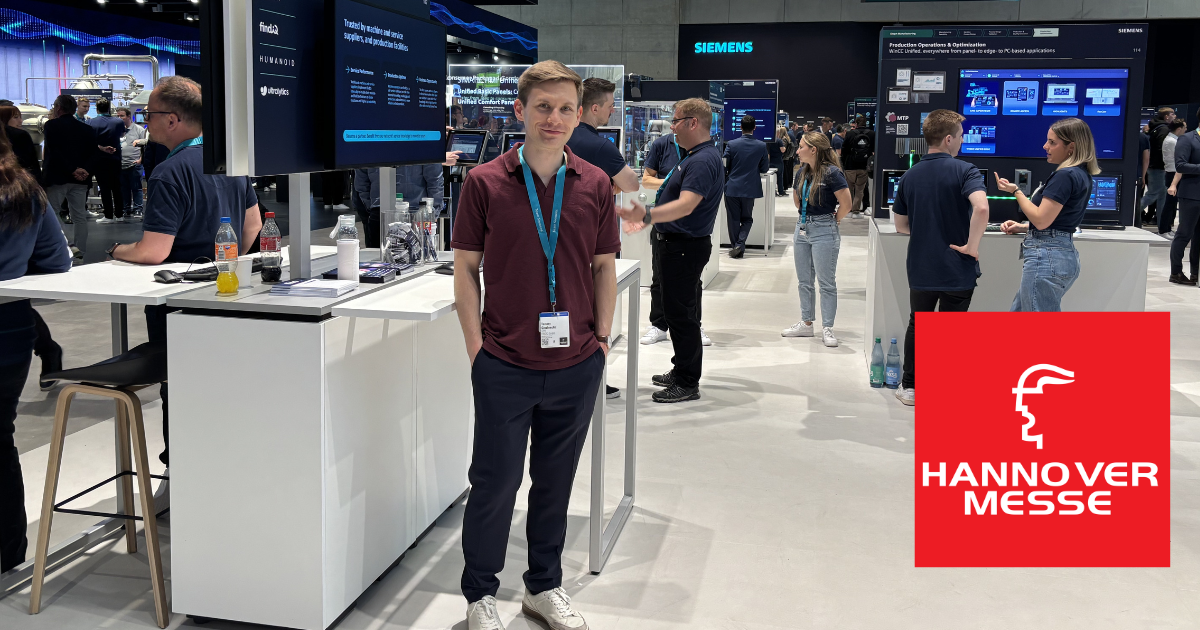
findIQ was present at the Siemens booth on April 20th. This was appropriate, given that findIQ is a Siemens Xcelerator Partner. The conversation in Hanover reinforced something we already knew: the Industrial AI ecosystem is large, growing, and increasingly crowded. Which makes differentiation more important, not less.
findIQ's approach differs from most of what was on the floor in three specific ways.
First, we start with experiential knowledge, not existing data. The expertise of experienced service technicians isn't stored in PDFs or databases. It lives in people's minds. findIQ captures that knowledge in a structured way, links it in a dynamic model, and makes it accessible to any technician regardless of their experience level or whether the original knowledge holder is still available.
Second, our diagnostic core is deterministic, not generative. findIQ does not generate text. It connects symptoms, causes, and probabilities in a structured heat map. The output is a precise, reproducible recommended action — not a creative answer with a margin of error. On average, the system guides technicians to the root cause in six steps, with a hit rate of at least 80%.
Third, our new assistant Quinn adds an LLM-based layer; deliberately and in its right place. Quinn handles what language models do well: building knowledge from unstructured sources, documenting service cases, generating reports. What Quinn does not do is replace the diagnostic logic. The deterministic core stays exactly as it is.
What this means for industrial companies
HANNOVER MESSE 2026 was a reality check in both directions. It showed how broadly Industrial AI has entered the mainstream. And it showed how large the gap remains between what gets demonstrated at exhibition booths and what actually works on the shopfloor.
If you're translating the week's insights into action, three questions are worth asking. Which problem in your operation has the greatest leverage, and does it actually require a large-scale generative AI solution, or a specialized one built for precision? Are the future users — service technicians, maintenance staff, machine operators — involved from the start? And is realization being planned, or just technology selection?
Industrial AI is not a commodity. It is a tool. Like any tool, the application determines whether it makes a difference. At findIQ, we built this tool before it had a name. And we know from experience: the name alone changes nothing on the shopfloor.
findIQ is the first Industrial Knowledge Intelligence platform — turning expert know-how into precise, scalable maintenance and troubleshooting guidance technicians can trust.
What was the main theme of HANNOVER MESSE 2026?
Industrial AI dominated HANNOVER MESSE 2026, with more than 3,000 exhibitors and 110,000 visitors. Shopfloor agents, AI-powered production assistants, autonomous systems, and humanoid robots were showcased across the exhibition floor. The central question that emerged for findIQ, however, was not whether Industrial AI exists — but whether it has actually reached the shopfloor in practice.
What is the difference between generative AI and the industrial AI approach findIQ uses?
Generative AI and large language models are well suited to tasks like documentation, reporting, and natural language configuration. They are not well suited to diagnostic work, where precision is non-negotiable. findIQ uses a deterministic, model-based AI that mirrors expert reasoning rather than generating probabilistic text. The result is a consistent, reproducible answer; not a creative one with a residual risk of error.
Why does user adoption matter as much as technology selection in industrial AI?
The outcome of any industrial AI deployment depends on three factors: the size of the knowledge gap being addressed, how much of that potential the technology unlocks, and whether the solution is actually used in the field. If adoption is zero, the result is zero — regardless of the technology's capability. findIQ builds its implementation methodology around the technicians who use the platform every day, which is why field adoption rates consistently exceed expectations.
What should industrial companies take away from HANNOVER MESSE 2026?
Three questions are worth asking before translating trade fair insights into action. Which operational problem has the greatest leverage, and does it require generative AI or a more specialized solution? Are future users including technicians, maintenance staff and operators involved from the start of the process? And is the plan focused on realization, or just technology selection? Companies that answer those questions honestly tend to get more from their Industrial AI investments.
What is findIQ's Quinn assistant and how does it complement the platform?
Quinn is findIQ's LLM-based assistant, designed to handle tasks where language models genuinely excel: building knowledge from unstructured sources, documenting service cases, and generating reports. Quinn does not replace findIQ's deterministic diagnostic core. The two layers work together; structured AI for precision diagnostics, generative AI for knowledge capture and documentation.
What makes findIQ different from other knowledge management solutions?
findIQ is the first AI-supported knowledge platform purpose-built for industrial service and operations. We combine deep expertise in manufacturing environments, proven knowledge preservation methods, flexible deployment options, and dedicated customer success support to ensure sustainable digital transformation.
How does findIQ approach the implementation of industrial AI in manufacturing and service environments?
findIQ starts with the problem, not the technology. The first step is capturing the experiential knowledge of the most experienced technicians through structured interviews and workshops. That knowledge is then structured into a dynamic diagnostic model accessible to any technician, regardless of experience level. IT is an enabler in that process. The people at the machines are at the center because they are the ones who determine whether the solution succeeds.